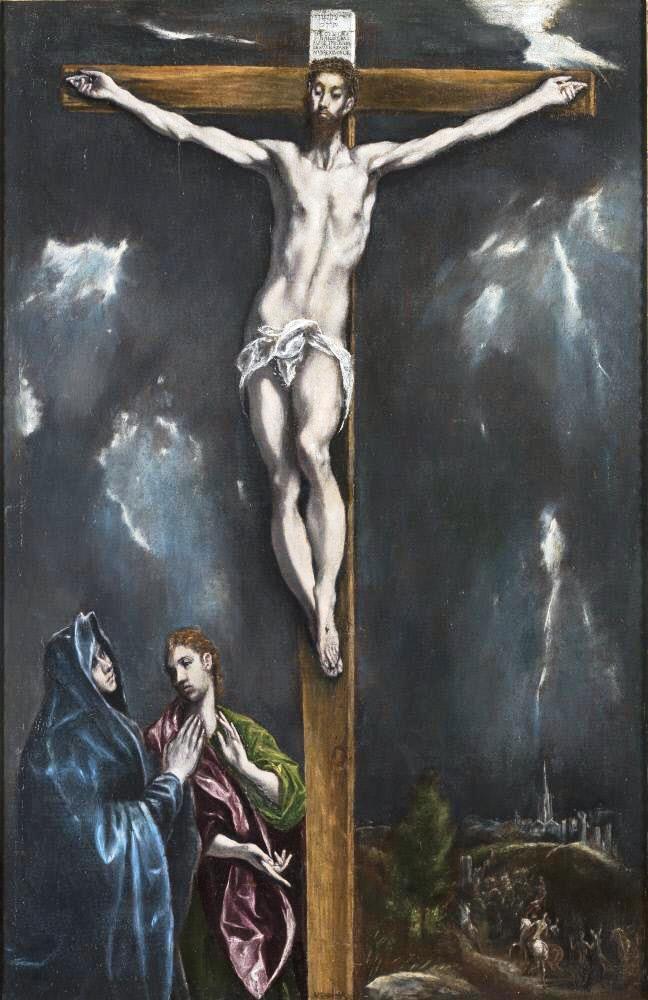
Scripture
Standing by the cross of Jesus were his mother and his mother’s sister, Mary the wife of Clopas, and Mary of Magdala. When Jesus saw his mother and the disciple there whom he loved, he said to his mother, “Woman, behold, your son.” Then he said to the disciple, “Behold, your mother.” And from that hour the disciple took her into his own home. — John 19:25–27
The Event
Stabat Mater — She Stood
The Gospels record that the disciples fled when Jesus was arrested in Gethsemane. The Fourth Gospel notes that the beloved disciple returned, and was present at the foot of the Cross. But among the four evangelists, only John explicitly places Mary at Calvary — standing (stabat) beside the Cross, alongside three other women. That single word — stabat, she stood — became the foundation of one of the greatest meditations in Christian history.
For three hours darkness fell over the whole land, until he breathed his last. During those hours, Mary witnessed everything: the soldiers dividing his garments, the crowd mocking, the two criminals crucified beside him, the sign "Jesus of Nazareth, King of the Jews" nailed above his head. She was close enough to hear his seven words from the cross. She was close enough to hear his breathing.
At some point in those three hours, Jesus looked down from the cross and gave her to the beloved disciple — and him to her. "Woman, behold your son." "Son, behold your mother." The Church has always understood this as more than a practical arrangement for Mary's care after his death. In this moment, from the Cross, Jesus makes Mary the mother of all his disciples.
Historical & Theological Context
Queen of Martyrs
The Church has given Mary the title Queen of Martyrs not because she died for the faith — she did not — but because her spiritual suffering at the Cross was of a magnitude that exceeded all physical martyrdom. This is not rhetoric. The theological argument, developed most fully by St. Bernard of Clairvaux and St. Alphonsus Liguori, rests on the principle that the intensity of suffering is proportional to the intensity of love. No one loved Jesus as his mother loved him. Therefore no one suffered with him as she suffered.
The Stabat Mater Dolorosa, the 13th-century Latin hymn traditionally attributed to Jacopone da Todi, is the definitive literary expression of this moment. It meditates on Mary standing at the foot of the Cross, describes her grief in terms of unprecedented compassion, and culminates in a prayer to share in her sorrows and be united with Christ through them. The hymn was restored to the Roman liturgy by Pope Benedict XIII in 1727 and is sung at the September 15 feast of Our Lady of Sorrows to this day.
Mary's Interior Experience
The Completion of the Sword
Simeon had prophesied that a sword would pierce her soul. Here, at the foot of the Cross, in the sixth hour of darkness, that prophecy reaches its fullest expression. Every grief she had carried since the Temple in Jerusalem — the Flight, the Three Days' Loss, the meeting on the Via Dolorosa — was contained in this moment and surpassed by it.
What did Mary's soul hold in those three hours? The tradition does not speculate idly, but it does reflect. She held her faith — a faith that, in this moment, was stripped of all consolation, all visible sign, all support except the naked word of God. She held her love — a love that could not be separated from its object by suffering or death, only deepened by it. And she held, the tradition believes, a foreknowledge of the Resurrection — not as comfort that softened the grief, but as the ground that made it possible to remain standing.
This is the center of the Seven Sorrows devotion. Everything before has been preparation for this. Everything after will be its completion. Mary at the Cross is the human soul at the absolute limit of suffering, held there not by her own strength but by a grace that surpasses understanding — and remaining, by that grace, fully present to the Son she cannot save and the God she will not abandon.
Prayer
Pray one Our Father and seven Hail Marys in meditation on this mystery. View prayer texts
Then return to the Rosary to continue with the Sixth Sorrow.
← Return to the Rosary