Scripture
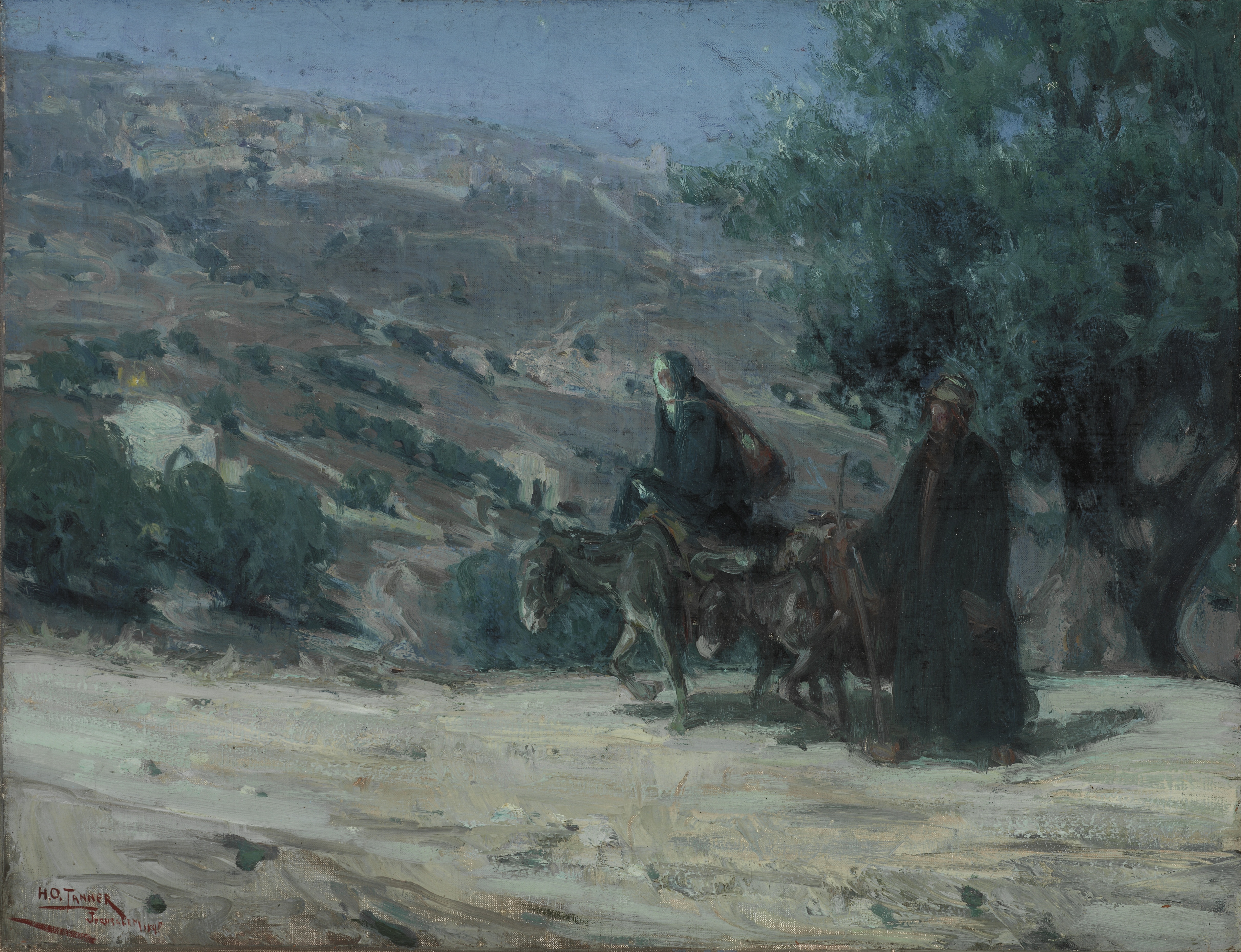
When they had departed, behold, the angel of the Lord appeared to Joseph in a dream and said, “Rise, take the child and his mother, flee to Egypt, and stay there until I tell you. Herod is going to search for the child to destroy him.” Joseph rose and took the child and his mother by night and departed for Egypt. — Matthew 2:13–14
The Event
Exile in the Night
The warning came in a dream — to Joseph, not to Mary. She would have been wakened in the darkness by her husband's urgency: they had to leave immediately. Herod, whose jealousy had been inflamed by the visit of the Magi, had ordered the killing of every male child in Bethlehem under the age of two. The massacre that followed — the slaughter of the Holy Innocents — would mark the end of their first home.
The journey from Bethlehem to Egypt was not a short one. Ancient routes suggest a distance of approximately three hundred and fifty miles, crossing the Sinai desert. The Holy Family would have traveled by foot or on a donkey, carrying only what they could manage in haste. The infant Jesus was perhaps only months old — Herod's order to kill children up to two years of age suggests the Magi's visit, and the flight, may have come well after the birth. The road passed through desolate terrain: sand, heat by day and cold by night, the constant anxiety of soldiers who might be searching behind them.
Egypt was a refuge for Jewish refugees — there were established Jewish communities in Alexandria and elsewhere, and the Mosaic Law had deep roots there. But it was also a foreign land, a land of a different language and a different world. Mary arrived there as a refugee, with a newborn, with almost nothing.
Historical & Theological Context
Exile as a Pattern of Salvation
Matthew sees the Flight into Egypt through the lens of the Exodus. His quotation — "Out of Egypt I called my son" (Hosea 11:1) — deliberately echoes the pattern of Israel's history: descent into Egypt, suffering in exile, and eventual return to the Promised Land. Jesus recapitulates in his own person the entire history of the people of God.
For Mary, this recapitulation is not an abstract theological truth but a lived experience. She and Joseph are the new Israel in miniature: forced into exile, sustained by God, waiting for the word to return. The difference is that she knows — or at least believes — who the child in her arms is. The weight of that knowledge in those circumstances is not comfort. It is its own kind of cross.
Mary's Interior Experience
The Sorrow of Displacement
There is a particular grief that belongs to exile — the loss not only of place but of belonging. Mary had been in Bethlehem for only a short time, far from her own family in Nazareth. Egypt would have been lonelier still. She would have had no mother, no cousin Elizabeth, no network of women who knew her and could help with the infant. In this foreign place, she was entirely dependent on Joseph and on God.
The Second Sorrow is the sorrow of vulnerability: of having no safe place, of being unable to protect your child by your own power, of being entirely in the hands of a providence you cannot see and can only trust. Mary held the infant Jesus in the Egyptian night and believed — without assurance from any human source — that this was where God intended them to be.
The devotion calls us to honor that faith. Not the faith that comes easily, with consolation and clarity, but the faith that holds in the dark, in a foreign country, with nothing to rest on but the word that came in a dream.
Prayer
Pray one Our Father and seven Hail Marys in meditation on this mystery. View prayer texts
Then return to the Rosary to continue with the Third Sorrow.
← Return to the Rosary