Scripture
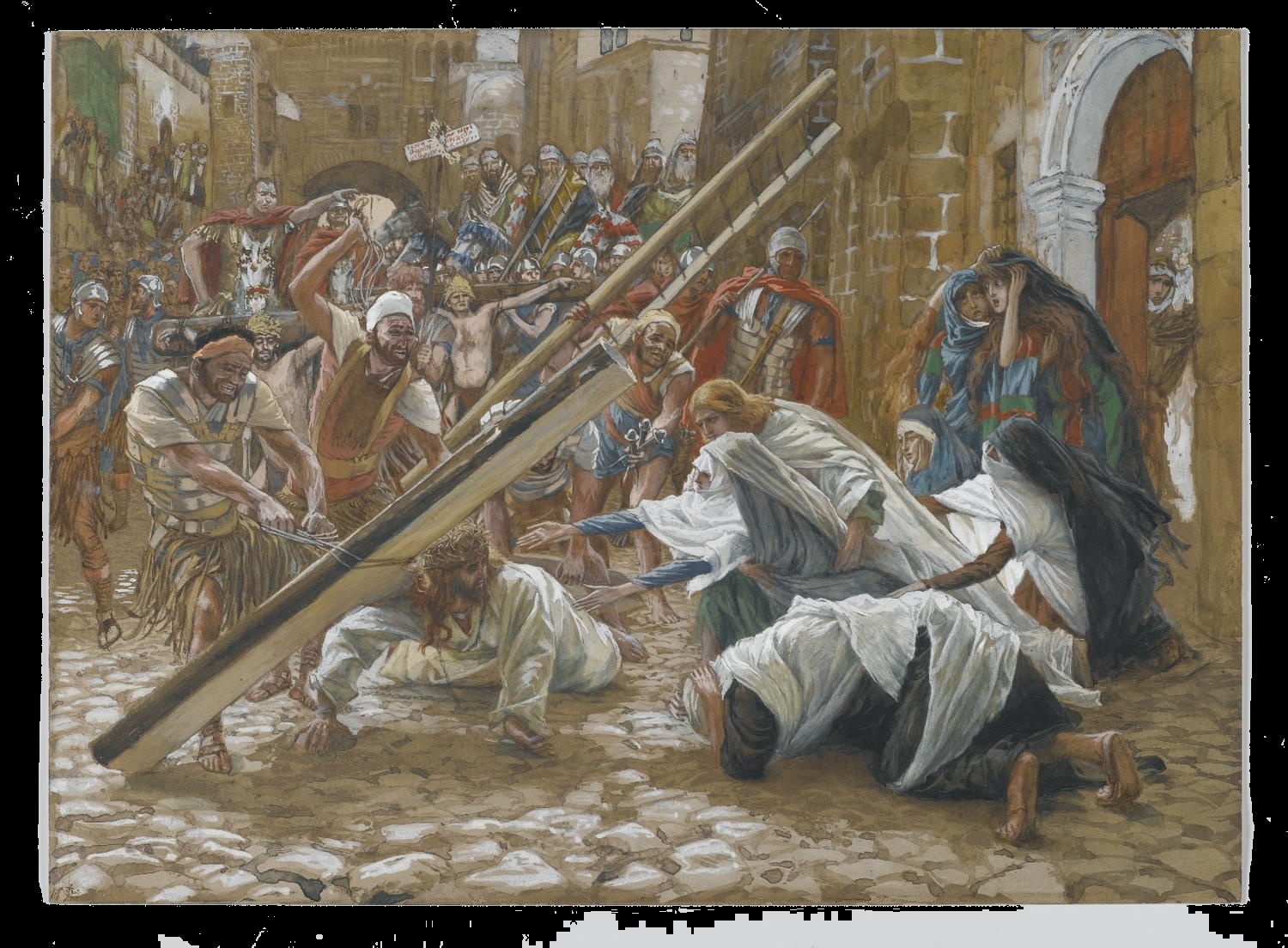
A large crowd of people followed Jesus, including many women who mourned and lamented him. Jesus turned to them and said, “Daughters of Jerusalem, do not weep for me; weep instead for yourselves and for your children.” — Luke 23:27–28
The Event
The Road to Calvary
The meeting of Jesus and his mother on the road to Calvary is not explicitly described in the four Gospels. Scripture places Mary at the foot of the Cross (John 19:25), and it records the women of Jerusalem who followed the procession (Luke 23:27). The tradition that Mary and Jesus met on that road — that their eyes found each other in that crowd — has been preserved not in text but in the devotion of centuries, most formally in the Fourth Station of the Cross.
The silence of Scripture here is itself significant. What passed between them in that moment is not recorded because it cannot be recorded. No language is adequate to it. The tradition simply says: they met. Their eyes found each other. And in that look was everything — thirty years of life together, the memory of Bethlehem and Egypt and Nazareth, the knowledge of what was happening and why, the love that would not leave.
He was carrying the crossbeam of his own execution. He had been beaten through the night, crowned with thorns, mocked in Pilate's courtyard. The journey from the Praetorium to Golgotha was perhaps half a mile through crowded, narrow streets. He fell at least three times under the weight. Into this scene, Mary arrived.
Historical & Theological Context
The Station of Shared Suffering
The Stations of the Cross as a formal devotion developed in Jerusalem from the 4th century onward, as pilgrims traced the route Jesus walked to Calvary. The Via Dolorosa — the Way of Grief — became a pilgrimage route, and eventually a devotion that could be practiced anywhere in the world. Pope Clement XII confirmed the fourteen stations in their current form in 1731.
The Fourth Station — Jesus meets his mother — is among the most contemplated. It is the station that most directly enters the mystery of Mary's compassion, her com-passio: her suffering with her Son. Theologians from Bernard of Clairvaux to John Paul II have reflected on this encounter as a moment in which the redemptive suffering of Christ was, in some unique way, shared by his mother. Not adding to it, not replacing it — but fully present to it.
Mary's Interior Experience
What It Means to Witness
There is a difference between knowing something will happen and seeing it happen. Mary had carried Simeon's prophecy for thirty years. She had known, in some form, that this was coming. But knowing and seeing are not the same. The man before her was her child, formed in her body, nursed at her breast, raised in her house. The distance between the prophecy and this moment on this road — that is the Fourth Sorrow.
She did not turn away. This is what the tradition emphasizes: that she came to him, that she stayed near him, that she did not protect herself from what she was seeing by distance or denial. The Stabat Mater will say of the Crucifixion that she "stood" (stabat) — not collapsed, not fled, but stood. That standing begins here, on the Via Dolorosa, before she reaches the hill.
The devotion invites us to reflect on what it means to witness suffering we cannot stop. Mary could not take the cross from her Son. She could not undo what was being done. She could only remain present — fully, without flight, without the armor of detachment. That presence, the tradition teaches, was itself a form of love, and a form of courage that surpassed that of all who fled.
Prayer
Pray one Our Father and seven Hail Marys in meditation on this mystery. View prayer texts
Then return to the Rosary to continue with the Fifth Sorrow.
← Return to the Rosary