Scripture
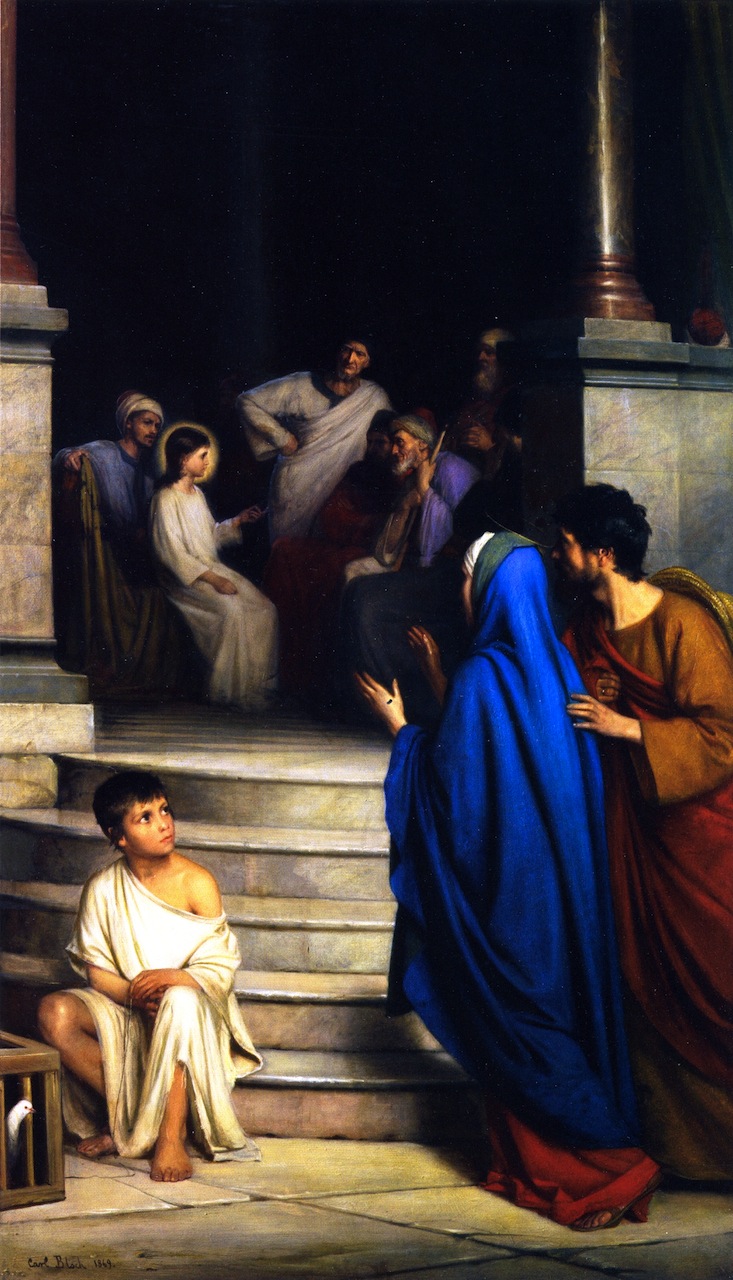
After three days they found him in the temple, sitting in the midst of the teachers, listening to them and asking them questions, and all who heard him were astounded at his understanding and his answers. When his parents saw him, they were astonished, and his mother said to him, “Son, why have you done this to us? Your father and I have been looking for you with great anxiety.” — Luke 2:46–48
The Event
Three Days in Jerusalem
The annual pilgrimage to Jerusalem for Passover was a community event. Families and neighbors traveled together in large caravans, and children would move freely among the group. It was not negligence that caused Mary and Joseph to travel a full day's journey before realizing Jesus was not with them — it was the ordinary trust of communal travel. They assumed he was with relatives or friends in the caravan. Only when they stopped for the night and he could not be found did the searching begin.
Luke records three days of searching. One day traveling away from Jerusalem, one day returning, and one day finding him in the Temple. Three days — the same number that would mark his burial. The parallel is not coincidental in Luke's Gospel, which is deeply attentive to these resonances. The Jerusalem that finally surrenders the twelve-year-old boy will be the Jerusalem that, twenty years later, will not.
They found him in the Temple precincts, seated among the teachers, listening and asking questions — suggesting he had placed himself there deliberately, as one who belonged. When Mary said, "Why have you done this to us?" he answered with a question: "Did you not know that I must be in my Father's house?" And Luke adds, quietly, that they did not understand what he said to them.
Historical & Theological Context
The Hidden Years and the Temple
The Finding in the Temple is the only event from Jesus's childhood recorded in the canonical Gospels after the Infancy Narratives. Between this episode and the beginning of his public ministry at approximately thirty years of age, the Gospels are silent — what tradition calls the "Hidden Years" at Nazareth. The Church has always seen in those hidden years a model of the ordinary Christian life: faithful, hidden, obedient, unremarkable to the world.
But the Temple episode punctuates that hiddenness with a sudden revelation. The boy Jesus, at the threshold of adolescence, is already fully oriented toward his Father's house. His presence among the teachers is not accidental. He is not lost — he is exactly where he intends to be. It is Mary and Joseph who are displaced, searching for someone who was never where they thought.
Mary's Interior Experience
Anxiety and the Limits of Understanding
Luke's language is precise: "Your father and I have been looking for you with great anxiety" (odunōmenoi — a word that can mean anguish, pain, grief). This is not a mild worry. Mary's question to her son is one of the only instances in the Gospels where she speaks with something close to reproach. The anxiety she felt over three days — the fear that something terrible had happened, that her child was gone — was the full experience of maternal anguish, unmitigated by mystical consolation.
What the Third Sorrow reveals is that Mary's relationship to the mystery of her Son was not one of constant clarity. She did not live in perpetual illumination. She "pondered these things in her heart" — she held them, turned them over, lived with what she could not yet fully understand. The sword of Simeon's prophecy was not only about the Passion. It was about the lifelong experience of loving someone whose identity and mission exceeded her full comprehension.
To contemplate the Third Sorrow is to enter into the experience of searching for God in the dark, and finding him in an unexpected place — not where we left him, not where we thought he should be, but in his Father's house, doing what he was always already doing.
Prayer
Pray one Our Father and seven Hail Marys in meditation on this mystery. View prayer texts
Then return to the Rosary to continue with the Fourth Sorrow.
← Return to the Rosary