Scripture
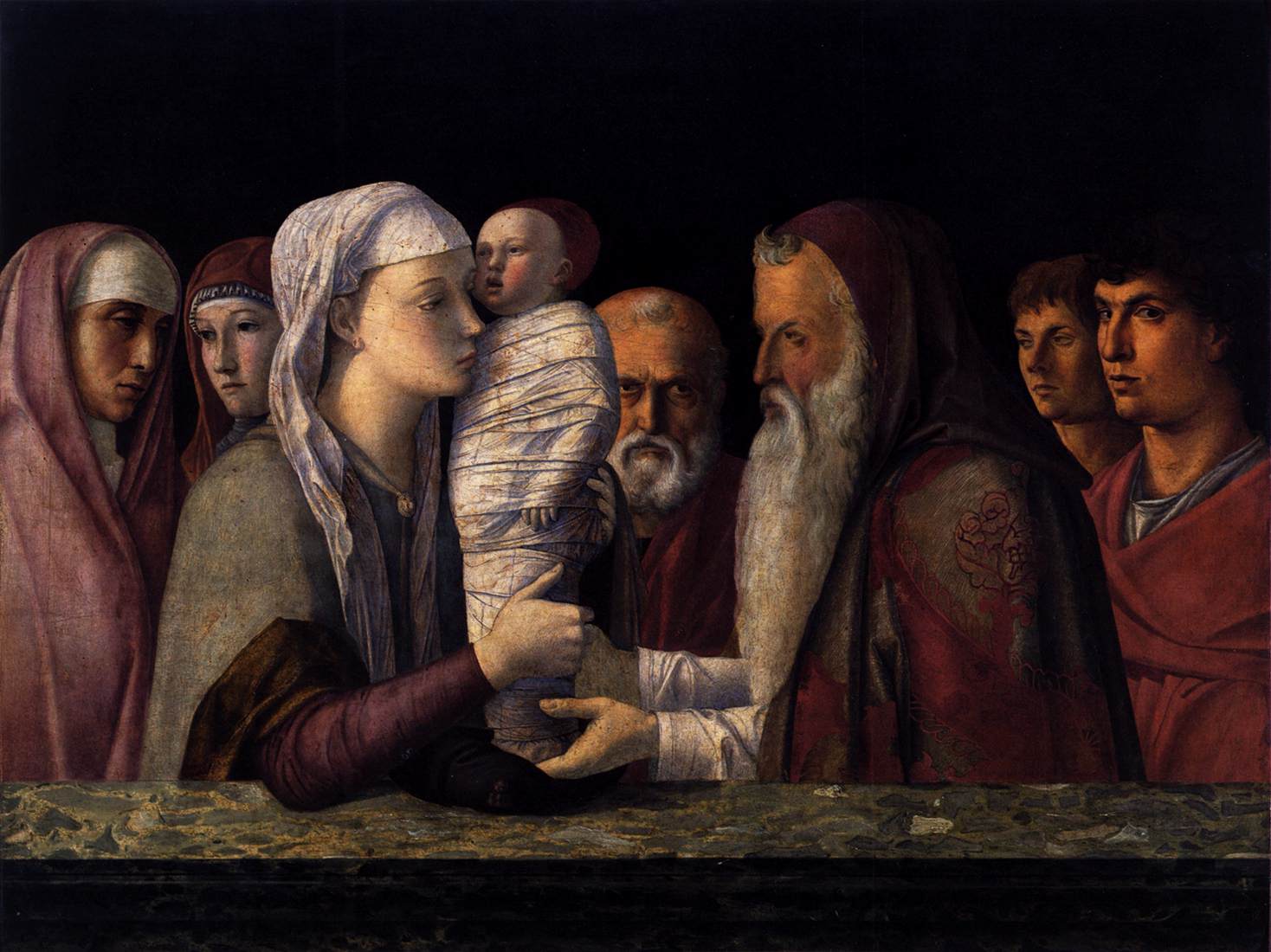
Simeon blessed them and said to Mary his mother, “Behold, this child is destined for the fall and rise of many in Israel, and to be a sign that will be contradicted — and you yourself a sword will pierce — so that the thoughts of many hearts may be revealed.” — Luke 2:34–35
The Event
The Presentation in the Temple
Forty days after the birth of Jesus, in obedience to the Law of Moses, Mary and Joseph brought the infant to the Temple in Jerusalem. They came as poor people come — their offering was two turtledoves, the provision made for those who could not afford a lamb (Leviticus 12:8). The Temple courts would have been crowded with pilgrims, priests, and merchants. It was an ordinary day of observance becoming an extraordinary one.
Among the worshippers was an elderly man named Simeon. Luke tells us that the Holy Spirit had revealed to him that he would not die before seeing the Messiah. Moved by the Spirit, he entered the Temple courts at precisely that moment. He took the infant Jesus into his arms and spoke a canticle of praise — the Nunc Dimittis: "Now, Lord, you may dismiss your servant in peace, for my eyes have seen your salvation." Then he turned to Mary.
What follows is among the most piercing sentences in the Gospels. Simeon looked at this young mother, holding her child, still in the early joy of new life, and told her what lay ahead. The sword he described was not a metaphor of mild discomfort. In Hebrew prophetic language, the sword piercing the soul signified a wound that would reach the innermost core of a person. The Greek word used — dierchesthai — means to pass through completely, from one side to the other.
Historical Significance
The Theological Foundation of the Devotion
This single verse — "a sword will pierce through your own soul also" — became the scriptural cornerstone upon which the entire devotion to the Seven Sorrows was built. From it, the Church drew the theological understanding that Mary was not a passive bystander to the Passion of her Son, but an active participant in his suffering. Her sorrow was not incidental but providential.
The Church Fathers recognized the weight of Simeon's words early. St. Ambrose of Milan (c. 340–397) wrote that Mary stood at the Cross not weeping as the weak weep, but as one who understood the mystery she was witnessing. St. Bernard of Clairvaux (1090–1153), in his commentary on this passage, asked: "What sword? Surely sorrow beyond measure, surpassing all martyrs." He is the probable origin of the title Queen of Martyrs applied to Mary — not because she died for the faith, but because her interior suffering exceeded that of all who did.
Mary's Interior Experience
What Mary Knew
There is a theological tradition, explored by theologians from Origen to Aquinas, that Mary understood — at least in its broad outlines — what Simeon's prophecy meant. She knew the scriptures. She would have known the suffering servant passages of Isaiah, the psalms of desolation, the prophecies of a Messiah who would be rejected. Simeon's words did not arrive into a vacuum.
What this means is that the First Sorrow was not only the beginning of Mary's grief — it was the beginning of a foreknowledge she would carry for thirty years. Every time she looked at her Son, she saw him against the backdrop of what was to come. Every moment of his childhood joy was already shadowed. Every laugh, every meal, every walk through Nazareth was held in that light.
The devotion invites us to contemplate not merely that Mary suffered, but how she suffered: with full awareness, with complete consent, and without wavering. The Fiat she spoke at the Annunciation — "Let it be done to me according to your word" — was not a single act. It was renewed every day of thirty years, in the knowledge of what that word would cost her.
Prayer
Pray one Our Father and seven Hail Marys in meditation on this mystery. View prayer texts
Then return to the Rosary to continue with the Second Sorrow.
← Return to the Rosary